
Patient education
Kidney stones
What causes kidney stone pain, how stones are treated, and the everyday steps that lower your risk of forming another one.
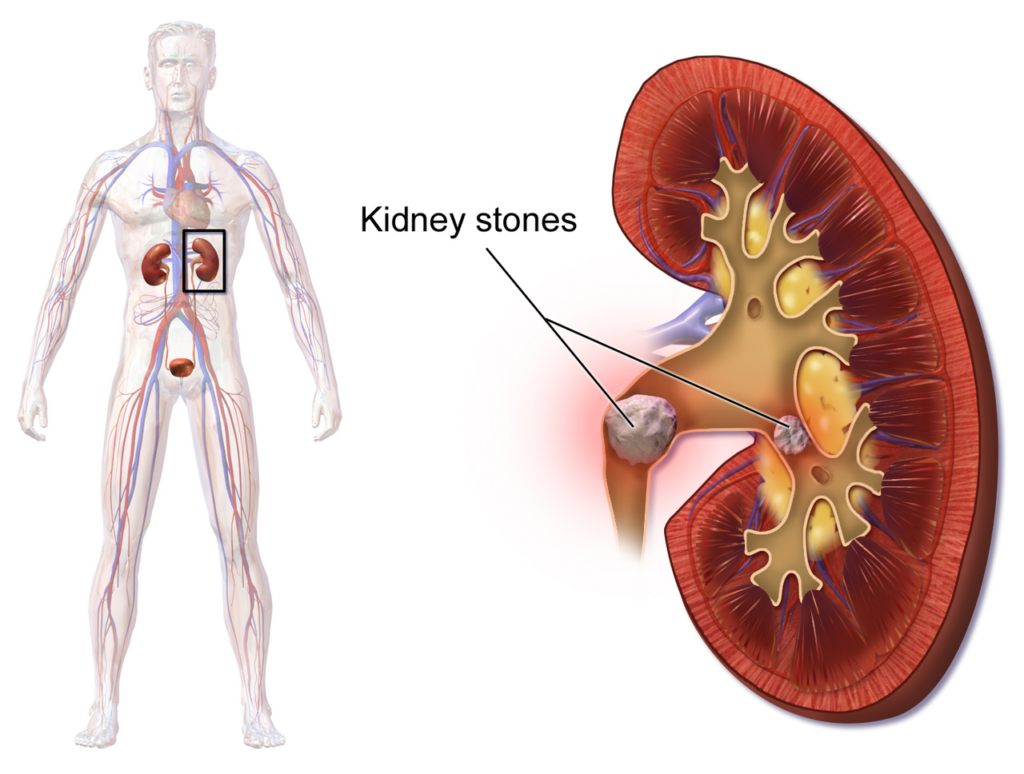
Illustration: BruceBlaus, CC BY 3.0, via Wikimedia Commons
Stones that pass on their own
Usually 1–6 mm (about ¼ inch)
Most common type
Calcium stones (~80%)
Chance of another stone
About 50% within 5–7 years
Best prevention
Plenty of water every day
Why stones hurt
Stones form inside the kidney when minerals in the urine crystallize. The severe, cramping pain in the back or side — often with nausea or vomiting — usually happens when a stone moves into the ureter, the narrow tube that carries urine to the bladder. Pain often eases once the stone reaches the bladder, and may briefly return as it passes out through the urethra. Some stones break into sand-like particles and pass without being seen.
Types of stones
There are four main types. About 80% are calcium stones, mostly calcium oxalate and some calcium phosphate. The others are uric acid stones, struvite stones (linked to past infections), and rare cystine stones. Knowing your stone type helps us tailor prevention.
Passing a stone at home
- Most small stones pass on their own within hours to several days.
- Drink plenty of fluids, mostly water, and stay active if the pain allows.
- Strain your urine each time you go until 24 hours after the pain stops, and bring any stone to your visit so it can be analyzed.
- Pink, red or brown urine is common while a stone passes.
- Ibuprofen or naproxen can help with pain unless you have kidney or liver disease, stomach ulcers or bleeding problems — ask us first if so.
When a stone needs treatment
If a stone is too large to pass, is blocking the kidney, or is causing infection or uncontrolled pain, it can be removed:
- Ureteroscopy with laser lithotripsy — a thin scope is passed through the urethra and bladder into the ureter or kidney; the stone is broken with a laser and removed with a tiny basket. There are no incisions, and most patients go home the same day. A temporary stent may be left for a few days to prevent swelling from blocking the kidney.
- Shock wave lithotripsy — sound waves from outside the body break the stone so it can pass.
- Surgery for large or complex stones, including robotic pyelolithotomy.
Preventing new stones
- Hydration first: drink enough water to make light-colored urine — for most people about 8 to 12 glasses a day, spread through the day and evening (unless you have heart or kidney conditions that limit fluids).
- Limit salt to about 2 grams a day; processed and canned foods are often high in salt.
- Keep normal calcium in your diet and pair calcium-rich foods with high-oxalate foods (such as spinach, rhubarb and nuts) so they bind in the gut.
- Eat more fruits and vegetables; citrus such as lemon juice adds citrate, which helps block crystal formation.
- Moderate animal protein, shellfish and alcohol, which raise uric acid; limit sugar and fructose, and avoid high-dose vitamin C supplements.
- Depending on your stone type and urine tests, medication may be recommended. Regular follow-up — every 3 to 12 months — helps catch new stones early.
When to call us
- Pain not controlled by your medication, or lasting more than 48 hours
- Fever of 100.4°F (38°C) or higher — this can be an emergency when a stone is present
- Repeated vomiting or you cannot keep fluids down
- You cannot urinate for 8 hours, or urine is very bloody with clots
- Weakness, dizziness or fainting — call 911
Call (424) 529-6755. For chest pain, trouble breathing, fainting or other emergencies, call 911.
This page is general education and is not a substitute for medical advice. Your evaluation and treatment plan will be personalized at your visit.
Ready to talk with Dr. Pooli?
New patients, second opinions, concierge and out-of-network PPO patients are welcome.