
Robotic surgery guide
Robotic pyelolithotomy
Removal of a large kidney stone by opening the kidney’s collecting system (renal pelvis) robotically, often in a single procedure.
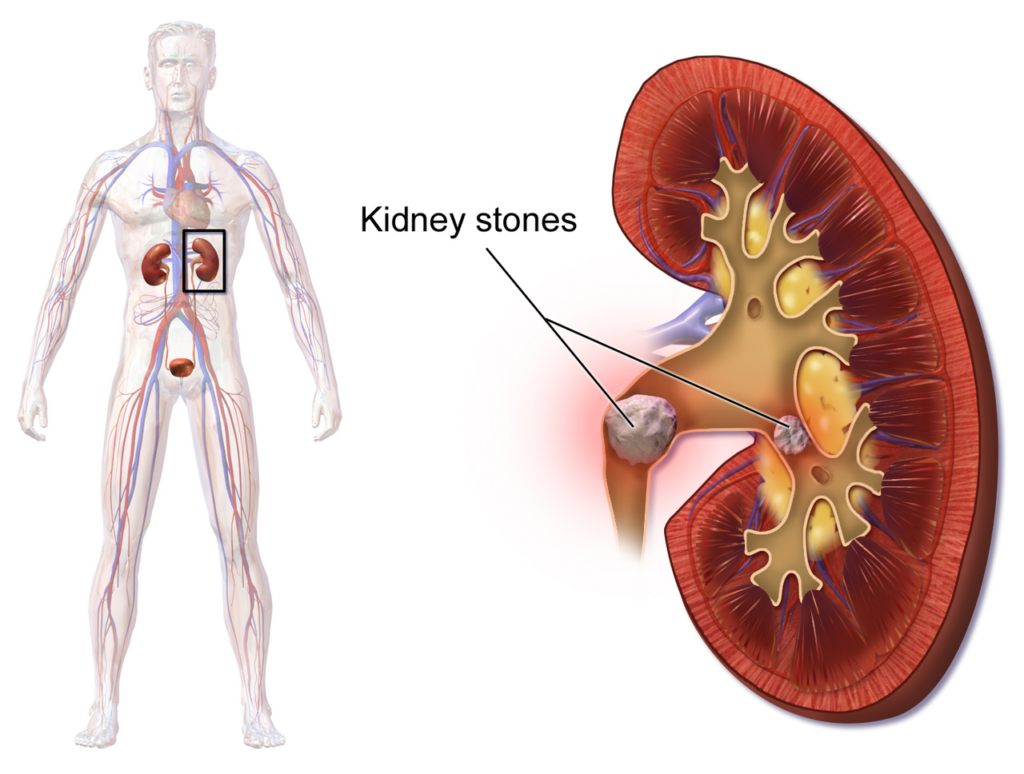
Illustration: BruceBlaus, CC BY 3.0, via Wikimedia Commons
Surgery time
About 2–3 hours
Hospital stay
Usually 1 night
Ureteral stent
About 2–6 weeks
Back to desk work
Usually 1–2 weeks
Typical ranges for most patients. Your own plan may differ — Dr. Pooli will review what to expect with you.
Who it’s for
Most kidney stones are treated without incisions, using ureteroscopy and laser or shock wave lithotripsy. Robotic pyelolithotomy is reserved for selected patients — for example a large stone in the renal pelvis, a stone together with a UPJ blockage that also needs repair (pyeloplasty), or anatomy that makes endoscopic treatment difficult.
How it works
Through small incisions, the renal pelvis is opened, the stone is lifted out whole, and the opening is closed with fine stitches. A flexible scope may be passed into the kidney to look for and remove smaller fragments. If a blockage is present, it can be repaired at the same time.
The stone is sent for analysis so we can recommend diet and medication to help prevent new stones.
What to expect
Before, during and after surgery
Step 1
Before surgery
- CT scan to map the stone
- Urine culture and treatment of any infection
- Stop blood thinners as instructed
- Nothing to eat or drink after midnight unless told otherwise
Step 2
During surgery
- General anesthesia, lying on your side
- 3–5 small incisions
- Stone removed through the renal pelvis
- Stent placed while the kidney heals
Step 3
After surgery
- Walking the same day
- Catheter usually removed before going home
- Stent removed in the office in about 2–6 weeks
- Drink plenty of fluids
- Stone analysis, metabolic testing and a prevention plan at follow-up
Possible risks
Robotic surgery is generally safe, and serious problems are uncommon. As with any operation, risks can include:
- Small leftover stone fragments
- Urine leak
- Bleeding
- Infection
- Stent discomfort
- Narrowing of the repaired area (rare)
When to call us
- Fever of 100.4°F (38°C) or higher
- Severe flank pain
- Unable to urinate
- Heavy bleeding or clots in the urine
- Any other symptom that worries you
Call (424) 529-6755. For chest pain, trouble breathing or other emergencies, call 911.
This page is general education and is not a substitute for medical advice. Every patient is different; your surgical plan, recovery timeline and instructions will be personalized at your consultation.
Ready to talk with Dr. Pooli?
New patients, second opinions, concierge and out-of-network PPO patients are welcome.