
Patient education
Prostate biopsy
A short procedure that takes tiny samples of prostate tissue to find out whether prostate cancer is present — and, if it is, how aggressive it is.
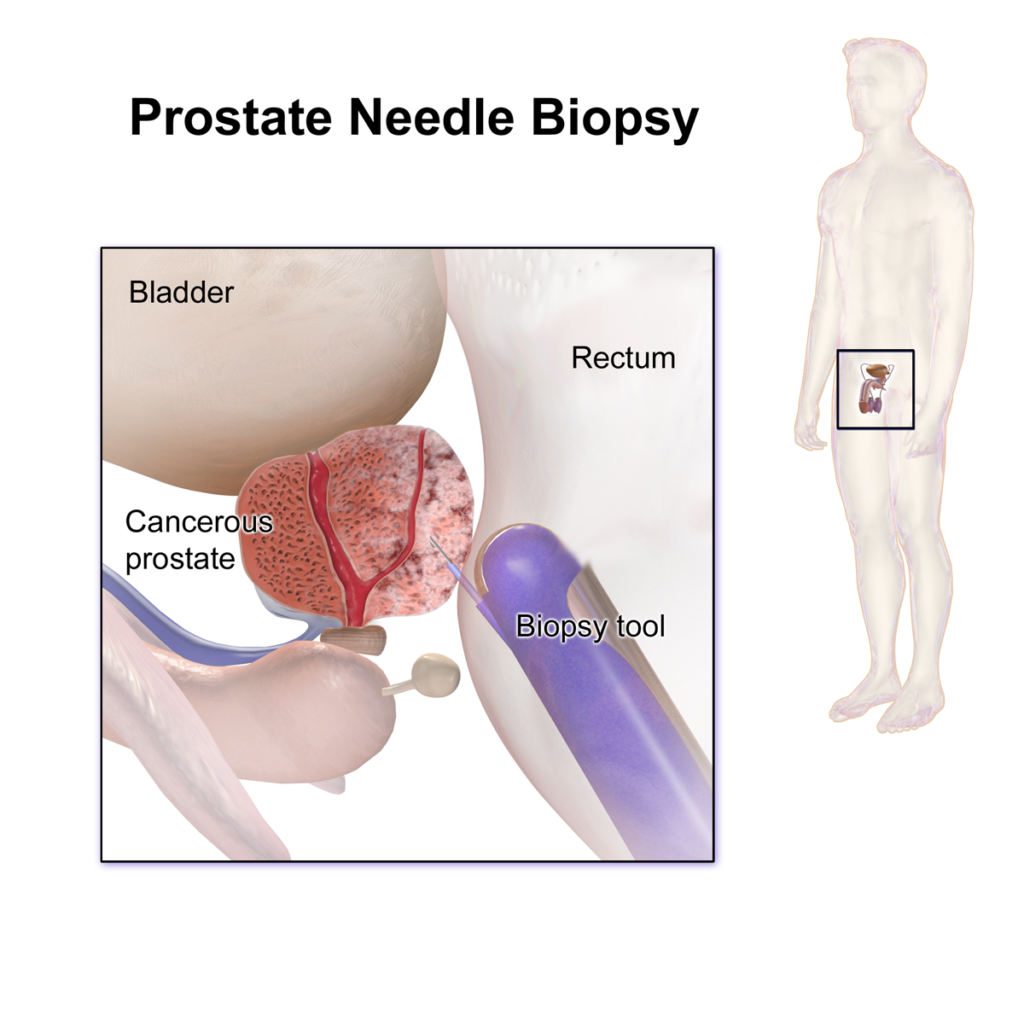
Illustration: BruceBlaus, CC BY-SA 4.0, via Wikimedia Commons
Procedure time
About 15–20 minutes
Anesthesia
Local, with or without sedation
Results
Usually within about a week
Back to normal
Usually the next day
Why a biopsy is recommended
A biopsy is usually advised when a PSA blood test is elevated or rising, a digital rectal exam feels abnormal, or a prostate MRI shows a suspicious area. It is the only way to confirm a diagnosis of prostate cancer.
Types of biopsy
Dr. Pooli offers both ultrasound-guided (TRUS) biopsy and MRI-fusion biopsy. In a fusion biopsy, your MRI images are combined with live ultrasound so that any suspicious area can be targeted precisely, in addition to systematic samples from the rest of the gland. Usually about 12 samples (cores) are taken, plus targeted cores when an MRI lesion is present.
Before your biopsy
- Tell us about blood thinners, aspirin and supplements — you may be asked to pause them.
- An antibiotic is given before the biopsy to lower the risk of infection.
- You may be asked to use an enema or suppository beforehand to clear the bowel.
- If you are having sedation, arrange for someone to drive you home.
During the biopsy
You lie on your side. A small ultrasound probe is placed, the prostate is numbed with local anesthetic, and a thin needle takes the tissue samples. Most patients feel pressure and brief snapping sensations rather than significant pain.
After the biopsy
- Some blood in the urine or stool for a few days is common.
- Blood in the semen can last several weeks and is not harmful.
- Mild soreness may occur; avoid heavy lifting and strenuous exercise for 1–2 days.
- Drink plenty of fluids.
Understanding your results
A pathologist examines each sample. If cancer is found, it is given a Gleason score and Grade Group (1 to 5) that describe how aggressive it looks. Together with your PSA and imaging, this places the cancer in a risk group that guides the next step — from active surveillance for many low-risk cancers, to robotic prostatectomy or radiation therapy. Dr. Pooli will review the results and every option with you in person.
Possible risks
- Bleeding in the urine, stool or semen
- Infection — uncommon, but it can be serious and needs prompt treatment
- Temporary difficulty urinating (rare)
When to call us
- Fever of 100.4°F (38°C) or higher, or chills — call right away
- Heavy bleeding or large clots
- You cannot urinate
- Pain that keeps getting worse
Call (424) 529-6755. For chest pain, trouble breathing, fainting or other emergencies, call 911.
This page is general education and is not a substitute for medical advice. Your evaluation and treatment plan will be personalized at your visit.
Ready to talk with Dr. Pooli?
New patients, second opinions, concierge and out-of-network PPO patients are welcome.