
Robotic surgery guide
Robotic radical prostatectomy
Surgery to remove the prostate and seminal vesicles for prostate cancer, performed through a few small incisions with the da Vinci® robotic system.
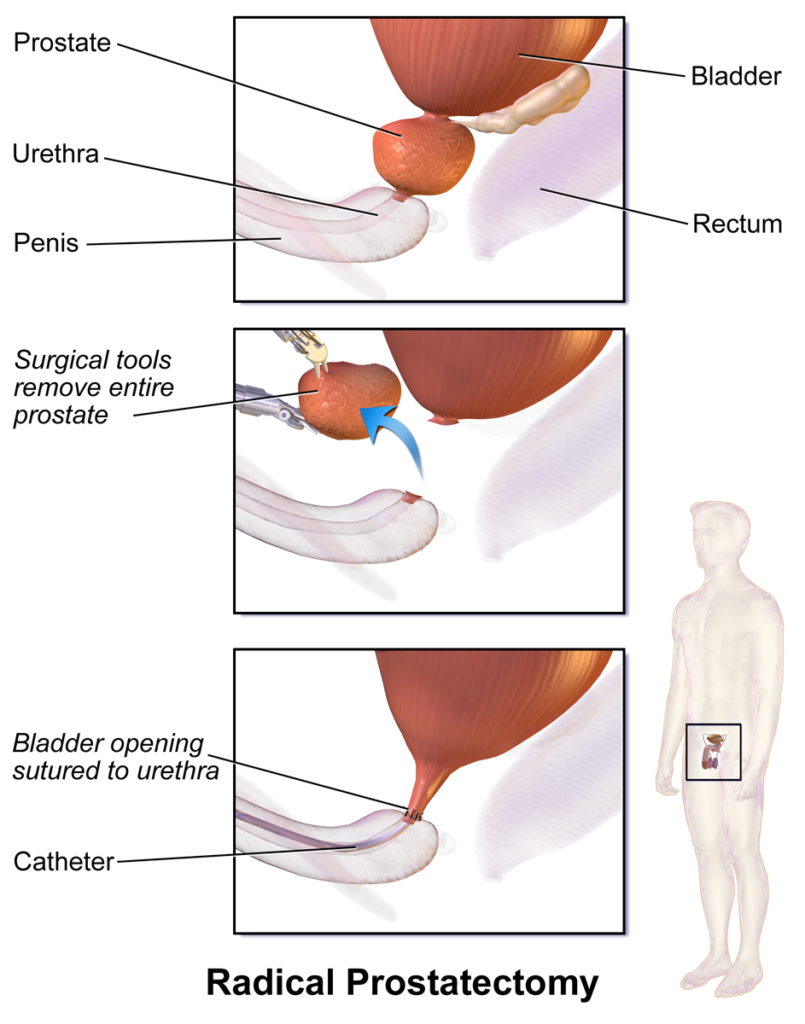
Illustration: BruceBlaus, CC BY-SA 4.0, via Wikimedia Commons
Surgery time
About 3–5 hours
Hospital stay
Same day to 2 nights
Urinary catheter
7–14 days
Back to desk work
Usually 2–3 weeks
Typical ranges for most patients. Your own plan may differ — Dr. Pooli will review what to expect with you.
Who it’s for
Men with prostate cancer that is confined to the prostate (localized) or in selected cases has spread just outside it, who are healthy enough for surgery and expected to benefit from removing the cancer.
For localized prostate cancer, the main options are active surveillance, surgery and radiation. Dr. Pooli reviews your PSA, MRI, biopsy and risk group with you so you can choose the approach that fits your cancer and your priorities.
How it works
The prostate and seminal vesicles are removed, and the bladder is reconnected to the urethra. Pelvic lymph nodes may be removed for staging.
Where cancer control allows, Dr. Pooli performs nerve-sparing surgery to protect erections, and may add a nerve wrap or peritoneal sling to support recovery. Compared with open surgery, the robotic approach typically means less blood loss and often a quicker return of urinary control.
What to expect
Before, during and after surgery
Step 1
Before surgery
- Review of your PSA, MRI and biopsy results, and medical clearance if needed
- Blood work and, if advised, a visit with your primary care or heart doctor
- Stop blood thinners and certain supplements only as instructed
- Start pelvic floor (Kegel) exercises
- Stop smoking — it slows healing
- Nothing to eat or drink after midnight unless told otherwise
Step 2
During surgery
- General anesthesia
- 5–6 small keyhole incisions in the abdomen
- Prostate and seminal vesicles removed; lymph nodes if needed
- Bladder reconnected to the urethra over a catheter
Step 3
After surgery
- Walking the same day or next morning
- Many healthy patients go home the same day; others stay 1–2 nights
- Catheter stays 7–14 days and is removed in clinic
- Resume Kegels after catheter removal; leakage usually improves over weeks to months
- No heavy lifting for about 4–6 weeks
- Pathology review and first PSA check at follow-up
Possible risks
Robotic surgery is generally safe, and serious problems are uncommon. As with any operation, risks can include:
- Bleeding, rarely needing a transfusion
- Infection
- Injury to the rectum, bowel or ureter (rare)
- Blood clots in the legs or lungs
- Heart, lung or anesthesia complications
- Urinary leakage, usually temporary
- Changes in erections
- Cancer that is not fully removed or returns
When to call us
- Fever of 100.4°F (38°C) or higher
- Catheter not draining or leaking heavily
- Swelling or pain in a leg
- Heavy bleeding or large clots in the urine
- Redness, swelling or drainage from an incision
- Any other symptom that worries you
Call (424) 529-6755. For chest pain, trouble breathing or other emergencies, call 911.
This page is general education and is not a substitute for medical advice. Every patient is different; your surgical plan, recovery timeline and instructions will be personalized at your consultation.
Ready to talk with Dr. Pooli?
New patients, second opinions, concierge and out-of-network PPO patients are welcome.