
Patient education
Transurethral resection of the prostate (TURP)
A proven surgery for an enlarged prostate (BPH) that removes the tissue blocking urine flow — performed through the urethra, with no incisions.
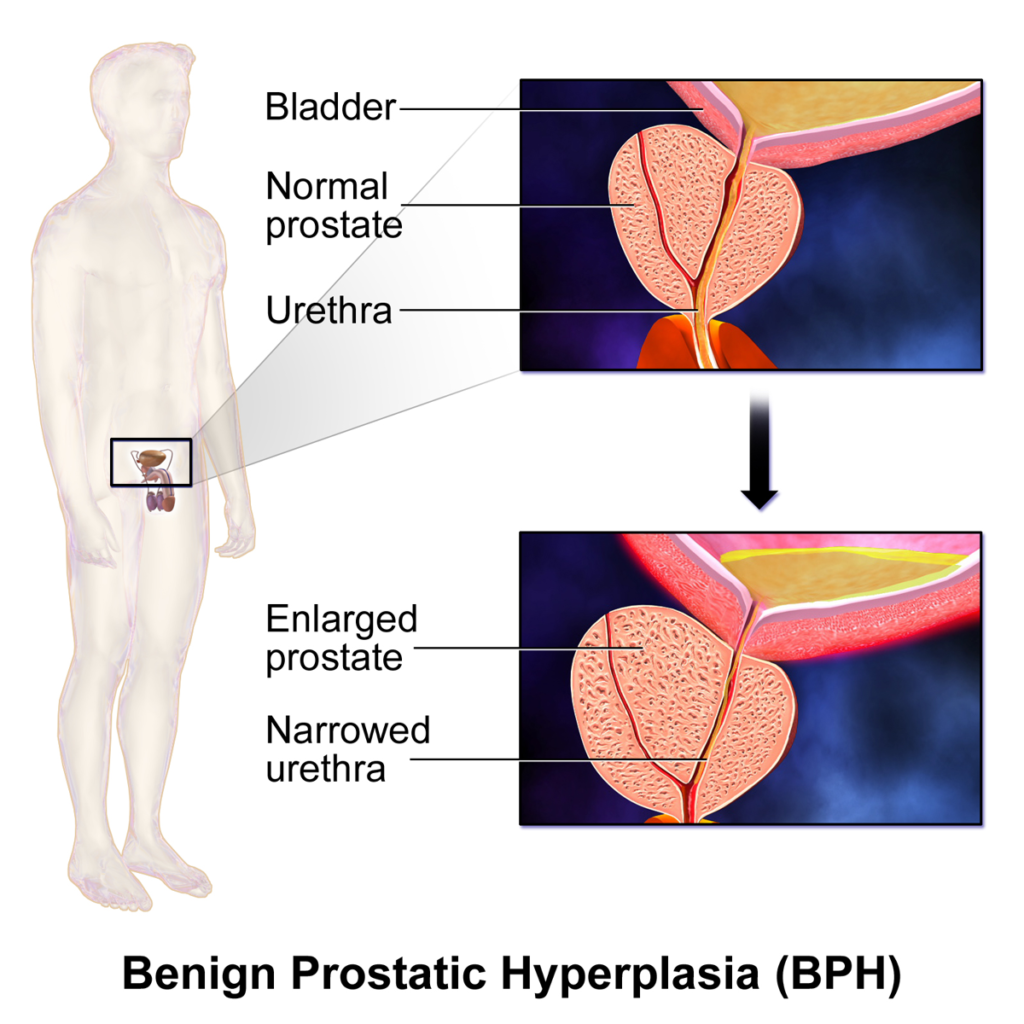
Illustration: BruceBlaus, CC BY-SA 4.0, via Wikimedia Commons
Procedure time
About 1 hour
Anesthesia
Spinal or general
Hospital stay
Usually home the same day
Full healing
About 4–6 weeks
When is surgery considered?
As the prostate enlarges, it can squeeze the urethra and make it hard to empty the bladder. Common symptoms include a weak stream, straining, a feeling of incomplete emptying, frequency, urgency, and waking up many times at night to urinate (nocturia).
When medications no longer control these symptoms well — or if there is urinary retention, repeated infections, bleeding, bladder stones or kidney strain — surgery may be the best option.
Choosing the right procedure
The best operation depends on how severe your symptoms are, the size and shape of your prostate, and how well your bladder works. Options range from in-office minimally invasive treatments such as UroLift and Rezum, to TURP and GreenLight laser vaporization (PVP), to robotic simple prostatectomy for very large prostates.
Dr. Pooli evaluates each patient carefully — including symptom score (IPSS), estimated prostate size and shape, and bladder function — and tailors the plan to you.
Dr. Pooli’s approach
Dr. Pooli often combines a traditional TURP with GreenLight laser vaporization to get the best of both: precise removal of obstructing tissue and excellent control of bleeding. Most patients go home just a few hours after surgery, rather than staying overnight as is common elsewhere.
How TURP is done
A thin instrument called a resectoscope is passed through the tip of the penis into the urethra. Using a small electrical loop (and laser energy when combined with PVP), the inner prostate tissue that blocks urine flow is removed in small pieces and flushed out. The pieces are sent to the lab for examination. A catheter is placed to drain the bladder while the area begins to heal.
Recovery at home
- The catheter is usually removed within a few days.
- Burning with urination and a frequent need to go are normal for the first few weeks and gradually settle.
- Urine may turn pink or red on and off for up to a month as the area heals — rest and drink extra fluids until it clears.
- Drink plenty of water, avoid constipation and straining, and avoid heavy lifting, strenuous exercise and sexual activity for about 4 weeks.
- Ask before restarting blood thinners or aspirin.
Possible risks
- Bleeding, occasionally needing a return to the operating room or a transfusion
- Urinary infection
- Dry orgasm (retrograde ejaculation) — common and not harmful, but it affects fertility
- Temporary difficulty urinating or urgency
- Scar tissue in the urethra or bladder neck (uncommon)
- Urinary leakage (rare) and erectile changes (uncommon)
When to call us
- Fever of 100.4°F (38°C) or higher
- You cannot urinate, or the catheter stops draining
- Bright red urine with clots that does not clear with rest and fluids
- Severe pain not relieved by medicine
Call (424) 529-6755. For chest pain, trouble breathing, fainting or other emergencies, call 911.
This page is general education and is not a substitute for medical advice. Your evaluation and treatment plan will be personalized at your visit.
Ready to talk with Dr. Pooli?
New patients, second opinions, concierge and out-of-network PPO patients are welcome.