
Robotic surgery guide
Robotic radical cystectomy & urinary diversion
Removal of the bladder for bladder cancer, with construction of a new way for urine to leave the body — performed robotically through small incisions.
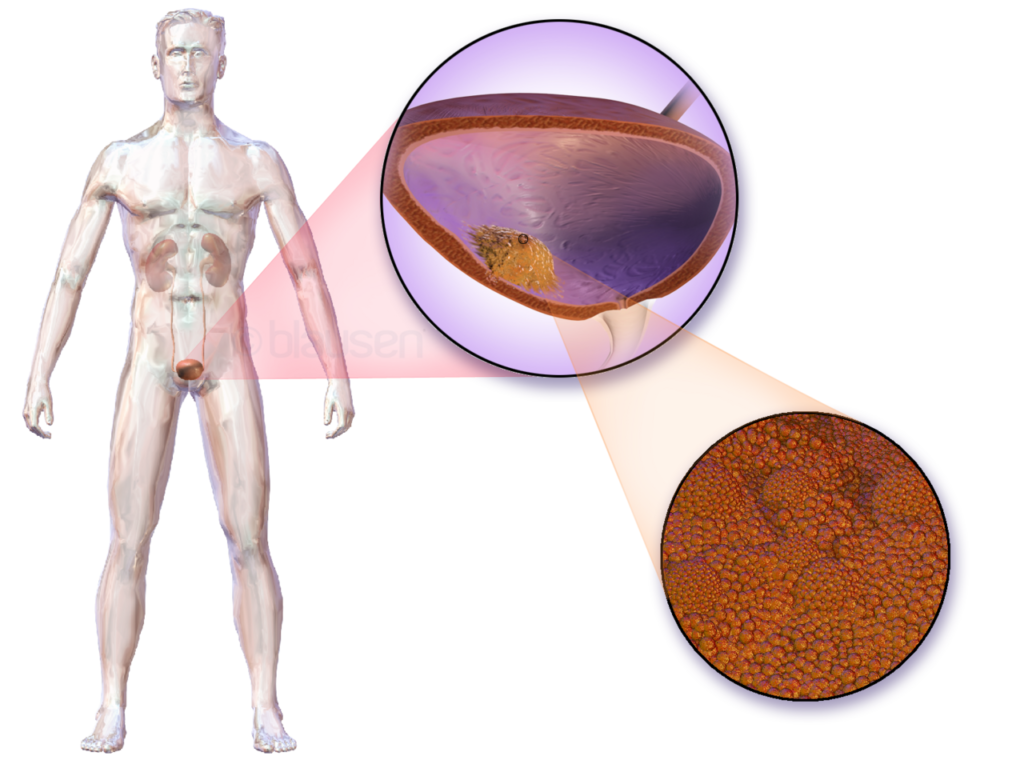
Illustration: Blausen Medical Communications, Inc, CC BY 3.0, via Wikimedia Commons
Surgery time
About 5–8 hours
Hospital stay
Usually 4–7 days
Ureteral stents
About 1–3 weeks
Full recovery
Usually 6–8 weeks
Typical ranges for most patients. Your own plan may differ — Dr. Pooli will review what to expect with you.
Who it’s for
Patients with bladder cancer that has grown into the bladder muscle, or high-risk non-muscle-invasive cancer that has not responded to treatments such as BCG. Chemotherapy is often given before surgery to improve results.
In men the prostate and seminal vesicles are usually removed with the bladder (cystoprostatectomy). In women, nearby organs such as the uterus, ovaries or part of the vagina may be removed, depending on the cancer. Pelvic lymph nodes are removed in both.
How it works
After the bladder and lymph nodes are removed, a short segment of intestine is used to create the urinary diversion:
- Ileal conduit — urine drains through a small opening on the belly (stoma) into a pouch you wear.
- Neobladder — a new internal bladder connected to the urethra, so you urinate through it, in selected patients.
Dr. Pooli will help you choose the option that fits your cancer, health and lifestyle.
What to expect
Before, during and after surgery
Step 1
Before surgery
- Staging scans, and chemotherapy beforehand if recommended
- Meeting with an ostomy (WOC) nurse to mark the stoma site and learn care
- Nutrition, walking and breathing exercises to prepare
- Stop smoking and blood thinners as instructed
- Clear liquids the day before if advised
Step 2
During surgery
- General anesthesia
- 5–6 small incisions; one slightly larger to remove the bladder
- Bladder, lymph nodes and nearby organs removed as needed
- Diversion built from intestine, with temporary stents in the ureters
Step 3
After surgery
- Early walking and eating on an enhanced-recovery pathway
- Ostomy or neobladder training before you go home
- Stents removed in about 1–3 weeks
- Home nursing support in the first weeks if needed
- No heavy lifting for about 6–8 weeks; pathology review and surveillance plan at follow-up
Possible risks
Robotic surgery is generally safe, and serious problems are uncommon. As with any operation, risks can include:
- Slow return of bowel function (ileus)
- Infection, including urinary and wound infection
- Bleeding and blood clots
- Urine or bowel leak at a connection
- Narrowing at a ureter connection, or stoma problems
- Changes in kidney function, vitamin B12 or acid–base balance over time
- Sexual function changes; readmission to hospital is not uncommon
When to call us
- Fever of 100.4°F (38°C) or higher
- Little or no urine from the stoma or catheter
- Vomiting, swollen belly or no bowel movement
- Redness, drainage or opening of an incision
- Swelling or pain in a leg
- Any other symptom that worries you
Call (424) 529-6755. For chest pain, trouble breathing or other emergencies, call 911.
This page is general education and is not a substitute for medical advice. Every patient is different; your surgical plan, recovery timeline and instructions will be personalized at your consultation.
Ready to talk with Dr. Pooli?
New patients, second opinions, concierge and out-of-network PPO patients are welcome.